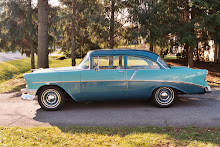
My neighbor shares community car magazines with me, specifically Automobile and Motor Trend. I appreciate this arrangement because it allows me to keep up on the latest car stuff without having to spend whatever car mag money I might in find the couch. I can save that for Street Rodder, Rod & Custom or other titles that I find both more interesting and more useful.
The November 2011 edition of Automobile features an article about Chevrolet’s 100th anniversary. As an owner of a “classic Chevy” and member of a Classic Chevy Club this probably should be of interest to me. As a matter of fact there were some bits of trivia that did tickle my fancy. One of the most interesting bits was the fact that Louis Chevrolet, the guy who gave his name to the marque (that’s pretentious car guy speak for brand name), quit his job rather than giving up cigarettes!
I was fascinated by the nearly century-long rivalry between Chevrolet and Ford, an epic struggle for market domination that, in recent years, has been overlooked because of a similar fight between Toyota and Honda. Chevy v. Ford began in earnest in 1915 when Chevrolet introduced a model that directly challenged the Model T by selling for the same $490. Chevrolet took the lead for the first time in 1927 (because Ford shut down for seven months to re-tool for the Model A) and again in 1928.
Chevy guys are justifiably proud of their small-block V8 which has pretty much owned it’s market (and engineering) niche for over sixty years. Not surprising considering its older brother, the “Stovebolt” Six, was the class of its class from 1929 until it was finally phased out in 1990. That makes it a little easier to swallow some of Chevrolet’s spectacular failures like the air-cooled engine installed in 1923 cars or the aluminum four-banger they put in Vegas.
Although the Vega will never be considered one of Chevrolet’s success stories, drag racer Bill “Grumpy” Jenkin’s Vega-based Pro-Stock Toy XI is considered a pioneer in its class due to innovations like a tube frame and MacPherson strut suspension. About the same time Grumpy was campaigning his Toys Chevrolet had its best sales year ever. In 1978 sales peaked at over 4.55 million. Funniest thing, is there a 1978 Chevrolet anyone today would walk across the street to look at, let alone buy?
By mid-century Chevrolet was in the driver’s seat sales-wise although Ford was riding shotgun. One market segment Chevy did not own, however, was the Hot Rod demographic. Ford’s dominated the pages of emerging car magazines like Hot Rod and Chevies were few and far between. That all changed with the introduction of the ’55 Chevy and it’s small block V8. Although Fords continued to supply the cars that became Hot Rods, the engines quickly became Chevy V8s.
During the car war years of the Sixties, Chevy and Ford battled toe-to-toe in the muscle car arena; Camaro v. Mustang pretty much defined that battle ground. It’s interesting that today, 50 years down the road, the skirmishing continues. In the first quarter of 2011 Camaro outsold Mustang for the first time in years. While Camaro spent a number of years in automotive limbo following its demise in 2002, Mustang soldiered on and even enjoyed a renaissance with a retro-redesign for the 2005 model-year. While Camaro fans cried in their beer Mustangs enjoyed record sales. Now, it seems, the tables have turned; according to USAToday,
“ . . . Chevrolet Camaro vs. Ford Mustang, it's no contest. Camaro is the winner. It's just one of the more interesting rivalries that are showing up in the sales numbers with the first quarter having just finished. Chevrolet sold 8,964 Camaros in March compared with Ford moving 8,557 Mustangs. For the first three months of the year, the score is 19,972 Camaros to 15,419 Mustangs. Last year, the two were neck-and-neck some months and Ford is justifiably proud of Mustang, so it's interesting that Camaro is pulling so far ahead.”
Most car folks agree the 1955 Chevrolet was the most important car of its generation. They say it dragged Chevrolet kicking and screaming into lead among American cars. Prior to the ‘55 Chevys were good, dependable family cars; kinda the Toyota Camry of their day. With the small block V8 and cutting-edge styling the ‘55 was apparently exactly what the mid-century American car buyer was looking for.
According to Robert Cumberford in the November, 2011 Automobile, the ‘55 grille was “ . . . the best grille in the entire history of Chevrolet,” even if they did steal it from Ferrari and only used it one year. It really is iconic; there’s no mistaking it for anything other than what it is.
One particular fun fact that grabbed my attention relates to the engine Chevy put in the 1990 Corvette ZR-1. Designated the LT5, it was a 5.7 liter all aluminum DOHC V8 built by Mercury Marine. I think the early versions were built to hang off the back of the car!
I’m glad Chevrolet has been rolling along for 100 years and now looks like it may make it for 100 more. Of course, now they have to find a reliable source for batteries or resist the urge to lower the price by selling them “batteries not included!”
Wednesday, December 28, 2011

Sunday, October 30, 2011
Confessions of a Drugstore Car Guy
Now that the 19th Annual Alzheimer’s Show is in the books it’s time to look toward the Big Two-O. It’s a landmark, right, and we need to do something appropriately awe-some, right? Each of the last few years have been more successful than the one be-fore; more cars, more money, more kudos each year. That track record has raised the bar pretty high and an escalation worthy of such a win streak could be hard to pull off. Not to worry, I’ve got just the gimmick! So how about we (HMCCC members) build and raffle off a hot rod? A Raffle Rod! Great idea, huh?
Over the last 20 years HMCCC has raised nearly a quarter-of-a-million-dollars for the Alzheimer’s Association and it would be very neat to kick things up a notch. I don’t know how much money we could raise with a raffle featuring a car as a prize but I’ll bet it would be a lot. I have done some research on using raffles as fundraisers and fund raising gurus all say you get more bang for your buck from a raffle than from other fundraising activities.
I think with a project like a Raffle Rod a few basic principles are important, the main one being K.I.S.S. (keep it sensibly simple). Also, keep it Classic or Old School and remember Occam’s Razor: Most of the time the simplest solution is the best one.
These concepts work well with the idea of building a ’32 Ford roadster. Not only is the ’32 roadster hi-boy a hot rod icon, it really is a pretty basic vehicle; fewer parts mean fewer things to go wrong. Also, like the small block Chevy engine (which, of course, we’ll use) parts and services are abundant and less expensive.
At our recent get-together to present HMCCC’s 2011 check to the Alzheimer’s Association there was a discussion about how much money we (HMCCC) raises for them (A.A.) with so little effort on their part. They (A.A.)told us (HMCCC) we had been giving them more money for longer than any other organization in this region. In 2012, considering how much more money we could raise with the Raffle Rod project, I think the Alzheimer’s Association will gladly pitch-in. As a matter of fact, we need their help to make the project a success.
A visit to the Alzheimer’s Association’s website (www.alz.org) makes it clear how a Raffle Rod campaign would benefit from their help. They have a national organization with a fund-raising apparatus in place. They have the ability to collect and process donations on-line, they have media contacts and various tools for publicizing their fund-raising projects. We can reach-out to friends and neighbors, pound the pavement, to sell raffle tickets. The Alzheimer’s Association can reach a national audience on the web, in the media and with their newsletters.
Those fund-raising gurus I’ve been consulting (via Google) say that a good raffle limits the number of tickets offered to entice buyers with better odds of winning. It also prices tickets high enough to discourage buyers from “buying” a win. I figure the Raffle Rod project should offer 5000 tickets at $25/ticket. The only deal offered would be five tickets for $100. This scenario would produce between $100,000 (all tickets sold @ 5/$100) and $125,000 (all tickets sold @ $25).
There are legal and regulatory issues that need to be addressed, including state and county permits, interim insurance, and provisions to meet tax requirements. There are administrative issues like how to manage accounting and reporting requirements. And there are emotional issues like who can and who can’t participate in the raffle. There is also the immediate issue of funding the project. Where will the money to buy the parts come from?
The biggest expense in the Raffle Rod project; the entire basis for it, in fact, is acquisition of a chassis. They are available and from vendors in the region but they’re not cheap. It’s easy to say the success and the quality of the entire project rests on this chassis. A Stage III, “rolling” chassis includes front and rear suspension, steering, brakes, the differential and all the bracketry to attach everything else to. Add a body, engine, transmission, etc., etc. and you’ve got a hot rod!
Although the 20th annual Alzheimer’s Show is 11 months away that is very little time in terms of a project like the Raffle Rod. Lots of issues need to be addressed in a very short amount of time. The Raffle Rod needs to be ready to roll-out not in September, in time for the drawing, but in the Spring. The car needs to hit the Cruise-in and Show circuit as soon as possible; the more it is seen, the more people will want to win it!
Anybody who’s ever put a car together knows that the list of what you need is see-mingly endless. To build the Raffle Rod were going to need all that stuff and maybe more. Many of us have parts laying around; things that didn’t get used on the last project, or that didn’t work when the project changed direction in mid-stream. Maybe we’ll be able to use some of that stuff. For sure we’ll be able to use your help.
At the October meeting we discussed the possibility of the Raffle Rod project and I was sent forth to learn and report back everything we need to know, do, and be pre-pared for. But they gave me until the November meeting to get that done. No problem; I’ll get what I can and make up the rest—the essence of hot rodding is improvisation!
I think every car guy has (or has had) the itch to build a real Classic, Old School Hot Rod and I think building the Raffle Rod and raising money for Alzheimer’s research is a great way scratch that itch. Think how good it’ll feel to see someone win the car we helped become a reality and how proud we’ll all be to make a pile of money for the Alz-heimer’s Association.
Let’s make the 20th Annual Alzheimer’s Show the one no one ever forgets!
Over the last 20 years HMCCC has raised nearly a quarter-of-a-million-dollars for the Alzheimer’s Association and it would be very neat to kick things up a notch. I don’t know how much money we could raise with a raffle featuring a car as a prize but I’ll bet it would be a lot. I have done some research on using raffles as fundraisers and fund raising gurus all say you get more bang for your buck from a raffle than from other fundraising activities.
I think with a project like a Raffle Rod a few basic principles are important, the main one being K.I.S.S. (keep it sensibly simple). Also, keep it Classic or Old School and remember Occam’s Razor: Most of the time the simplest solution is the best one.
These concepts work well with the idea of building a ’32 Ford roadster. Not only is the ’32 roadster hi-boy a hot rod icon, it really is a pretty basic vehicle; fewer parts mean fewer things to go wrong. Also, like the small block Chevy engine (which, of course, we’ll use) parts and services are abundant and less expensive.
At our recent get-together to present HMCCC’s 2011 check to the Alzheimer’s Association there was a discussion about how much money we (HMCCC) raises for them (A.A.) with so little effort on their part. They (A.A.)told us (HMCCC) we had been giving them more money for longer than any other organization in this region. In 2012, considering how much more money we could raise with the Raffle Rod project, I think the Alzheimer’s Association will gladly pitch-in. As a matter of fact, we need their help to make the project a success.
A visit to the Alzheimer’s Association’s website (www.alz.org) makes it clear how a Raffle Rod campaign would benefit from their help. They have a national organization with a fund-raising apparatus in place. They have the ability to collect and process donations on-line, they have media contacts and various tools for publicizing their fund-raising projects. We can reach-out to friends and neighbors, pound the pavement, to sell raffle tickets. The Alzheimer’s Association can reach a national audience on the web, in the media and with their newsletters.
Those fund-raising gurus I’ve been consulting (via Google) say that a good raffle limits the number of tickets offered to entice buyers with better odds of winning. It also prices tickets high enough to discourage buyers from “buying” a win. I figure the Raffle Rod project should offer 5000 tickets at $25/ticket. The only deal offered would be five tickets for $100. This scenario would produce between $100,000 (all tickets sold @ 5/$100) and $125,000 (all tickets sold @ $25).
There are legal and regulatory issues that need to be addressed, including state and county permits, interim insurance, and provisions to meet tax requirements. There are administrative issues like how to manage accounting and reporting requirements. And there are emotional issues like who can and who can’t participate in the raffle. There is also the immediate issue of funding the project. Where will the money to buy the parts come from?
The biggest expense in the Raffle Rod project; the entire basis for it, in fact, is acquisition of a chassis. They are available and from vendors in the region but they’re not cheap. It’s easy to say the success and the quality of the entire project rests on this chassis. A Stage III, “rolling” chassis includes front and rear suspension, steering, brakes, the differential and all the bracketry to attach everything else to. Add a body, engine, transmission, etc., etc. and you’ve got a hot rod!
Although the 20th annual Alzheimer’s Show is 11 months away that is very little time in terms of a project like the Raffle Rod. Lots of issues need to be addressed in a very short amount of time. The Raffle Rod needs to be ready to roll-out not in September, in time for the drawing, but in the Spring. The car needs to hit the Cruise-in and Show circuit as soon as possible; the more it is seen, the more people will want to win it!
Anybody who’s ever put a car together knows that the list of what you need is see-mingly endless. To build the Raffle Rod were going to need all that stuff and maybe more. Many of us have parts laying around; things that didn’t get used on the last project, or that didn’t work when the project changed direction in mid-stream. Maybe we’ll be able to use some of that stuff. For sure we’ll be able to use your help.
At the October meeting we discussed the possibility of the Raffle Rod project and I was sent forth to learn and report back everything we need to know, do, and be pre-pared for. But they gave me until the November meeting to get that done. No problem; I’ll get what I can and make up the rest—the essence of hot rodding is improvisation!
I think every car guy has (or has had) the itch to build a real Classic, Old School Hot Rod and I think building the Raffle Rod and raising money for Alzheimer’s research is a great way scratch that itch. Think how good it’ll feel to see someone win the car we helped become a reality and how proud we’ll all be to make a pile of money for the Alz-heimer’s Association.
Let’s make the 20th Annual Alzheimer’s Show the one no one ever forgets!
Wednesday, September 28, 2011
Real Time Reporting from HMCCC's 19th Annual Alzheimer's Show
Man, I love the sound of a lopey cam in the morning! We are opening the gates at the MVA at 8:00 the morning of the Alzheimer’s Show. They’re already backed-up damn near to the Interstate. Our annual third-Sunday-in-September Show is a great way to kick-off Fall so you gotta understand their eagerness.
Five ’til 9 o’clock and EZ just made his first announcement over the PA system. An hour and five minutes until the show starts and the main lot is already more than three-quarters full. They’ve already registered nearly 200 cars!
It’s a perfect early Fall morning, brisk and clear as a bell, a slight breeze to push the sounds of the cacklefest toward downtown Frederick—a little free advertising. Maybe we’ll get the attention of some of the early Fair-goers. By 9:30 the main lot is full and they’re parking cars in the overflow lot, well over 200 cars registered by now!
I appreciate the variety—the mix of vehicles this show attracts—plenty of antiques, classics, hot rods and muscle cars to be sure. A lot of interesting late model cars and trucks, too. One of the categories I like (although there’s no actual category) is the truly unique vehicles: EZ’s 100% hand-built Heinz 57 roadster, Bob Clubb’s Model T Paddy Wagon, a Jeep CJ disguised as an Urban Assault Vehicle, the three-wheeled, motorcycle-powered Lomax. The essence of hot rodding is expressing your individuality and showing to the world!
After so many years of ho-hum cars it is good to see late models that spark some interest. One in particular, a Cadillac CTS-V, is probably a future icon the way the high performance muscle cars are today. Another late model I picked for my own OCD Award was the White with Orange stripes Camaro that carried the color scheme under the hood and to the monster 24 inch wheels—lots and lots of white and orange.
One of the highlights of the Alzheimer’s Show each year is the Auction; I’m sure a bunch of the folks that come out don’t care much at all for the cars, they want to BID! This year we added a big tent just for the Auction and, by 10 0’clock the hard-core bidders were setting-up their chairs. Listening to John Roop’s spiel wears me out, though.
Another highlight, at least for me, was the Rick De Bow show over by the Moon Bounce. The rapport he seems to have with the kids warms the cockles of my Loman and Barkley heart, we’re lucky to have him over there! Thank you for sparing those kids having to be tended by a curmudgeon like me.
I thought this might be the year I finally get a trophy but darned if Paul didn’t outbid me. He got to take home the trophy and neither one of us had a car in the show. This year’s Alzheimer’s Show is going to be hard to beat but we’ve got the 20th coming up!
Five ’til 9 o’clock and EZ just made his first announcement over the PA system. An hour and five minutes until the show starts and the main lot is already more than three-quarters full. They’ve already registered nearly 200 cars!
It’s a perfect early Fall morning, brisk and clear as a bell, a slight breeze to push the sounds of the cacklefest toward downtown Frederick—a little free advertising. Maybe we’ll get the attention of some of the early Fair-goers. By 9:30 the main lot is full and they’re parking cars in the overflow lot, well over 200 cars registered by now!
I appreciate the variety—the mix of vehicles this show attracts—plenty of antiques, classics, hot rods and muscle cars to be sure. A lot of interesting late model cars and trucks, too. One of the categories I like (although there’s no actual category) is the truly unique vehicles: EZ’s 100% hand-built Heinz 57 roadster, Bob Clubb’s Model T Paddy Wagon, a Jeep CJ disguised as an Urban Assault Vehicle, the three-wheeled, motorcycle-powered Lomax. The essence of hot rodding is expressing your individuality and showing to the world!
After so many years of ho-hum cars it is good to see late models that spark some interest. One in particular, a Cadillac CTS-V, is probably a future icon the way the high performance muscle cars are today. Another late model I picked for my own OCD Award was the White with Orange stripes Camaro that carried the color scheme under the hood and to the monster 24 inch wheels—lots and lots of white and orange.
One of the highlights of the Alzheimer’s Show each year is the Auction; I’m sure a bunch of the folks that come out don’t care much at all for the cars, they want to BID! This year we added a big tent just for the Auction and, by 10 0’clock the hard-core bidders were setting-up their chairs. Listening to John Roop’s spiel wears me out, though.
Another highlight, at least for me, was the Rick De Bow show over by the Moon Bounce. The rapport he seems to have with the kids warms the cockles of my Loman and Barkley heart, we’re lucky to have him over there! Thank you for sparing those kids having to be tended by a curmudgeon like me.
I thought this might be the year I finally get a trophy but darned if Paul didn’t outbid me. He got to take home the trophy and neither one of us had a car in the show. This year’s Alzheimer’s Show is going to be hard to beat but we’ve got the 20th coming up!
The Roads Scholar
The sign above the highway is telling me: Report Suspicious Activity, 800-492-8477. I wonder what I should be watching-out for. Well, on one recent trip I saw a car in which the driver was wearing some kind of bulky head covering; that proved to be a false alarm, however, when the lady took the towel off her wet hair and began blow-drying it.
Another time I passed a woman who was applying her make-up as she drove. I didn’t think that needed to be reported, it’s certainly wasn’t unusual except, in this case, I had a suspicion that she was wasting her time, the make-up wasn’t going to do that much good.
The other evening I was passed by a whole group of motorcycles, the riders all tricked-out in their drugstore biker garb. Back in the day I could have reported a gang of outlaw bikers, probably armed and carrying illegal drugs. Today I suspect they’re carrying AARP membership cards and a weekend supply of Viagra.
After seeing that Report . . . sign again I finally put their number at #1 on my speed dial. My only concern is; if I get caught using my cell phone to report suspicious activity while driving will I get a ticket? I my call saves all from getting blown to smithereens will my fifteen minutes of fame (I will get that, right? If not, why bother making the call?) trump the calling-while-driving fine?
I’m so embarrassed! I just passed a truck full of fertilizer that I thought might have been hijacked (by whoever it is we’re afraid of) to be used as a bomb. I called “the number” and told the person who answered what I’d seen. The first question I was asked was how did I know the truck was carrying fertilizer? Duh, it was written right on the bags: C-O-W M-A-N-U-R-E! Then the person told me that that’s not the kind of fertilizer used to make bombs.
One of the most common suspicious activities I see on the highway is folks masquerading as clever with cute or witty vanity plates. I mean, how smart is it to admit you are 2DUM2NO? Or that you got the car 4BN EZ? Some vanity plates say so much more than just a handful of letters and numbers, like the defense attorney’s plate CRIMPAZ.
The plate CARGASM, on the other hand, raises more questions than it answers. For in-stance, is this something that’s happening to the car or the driver? If it’s the driver does it happen all the time or just after certain maneuvers? If it’s the car, how do we know it’s not just faking?
Another time I passed a woman who was applying her make-up as she drove. I didn’t think that needed to be reported, it’s certainly wasn’t unusual except, in this case, I had a suspicion that she was wasting her time, the make-up wasn’t going to do that much good.
The other evening I was passed by a whole group of motorcycles, the riders all tricked-out in their drugstore biker garb. Back in the day I could have reported a gang of outlaw bikers, probably armed and carrying illegal drugs. Today I suspect they’re carrying AARP membership cards and a weekend supply of Viagra.
After seeing that Report . . . sign again I finally put their number at #1 on my speed dial. My only concern is; if I get caught using my cell phone to report suspicious activity while driving will I get a ticket? I my call saves all from getting blown to smithereens will my fifteen minutes of fame (I will get that, right? If not, why bother making the call?) trump the calling-while-driving fine?
I’m so embarrassed! I just passed a truck full of fertilizer that I thought might have been hijacked (by whoever it is we’re afraid of) to be used as a bomb. I called “the number” and told the person who answered what I’d seen. The first question I was asked was how did I know the truck was carrying fertilizer? Duh, it was written right on the bags: C-O-W M-A-N-U-R-E! Then the person told me that that’s not the kind of fertilizer used to make bombs.
One of the most common suspicious activities I see on the highway is folks masquerading as clever with cute or witty vanity plates. I mean, how smart is it to admit you are 2DUM2NO? Or that you got the car 4BN EZ? Some vanity plates say so much more than just a handful of letters and numbers, like the defense attorney’s plate CRIMPAZ.
The plate CARGASM, on the other hand, raises more questions than it answers. For in-stance, is this something that’s happening to the car or the driver? If it’s the driver does it happen all the time or just after certain maneuvers? If it’s the car, how do we know it’s not just faking?
Wednesday, August 31, 2011
Confessions of a Drugstore Car Guy
I recently joined my friend Paul on a road trip to deliver what some might charitably characterize as collectible automobiles. I wouldn’t be that generous. In fact, if we accomplished nothing else I believe we proved the old adage that one man’s treasure is another man’s trash.
The first leg of the trip, which we undertook after a leisurely breakfast to allow morning rush hour traffic to abate, was to deliver a 1938 Citroen to Falls Church, VA. Don’t get me wrong, I don’t have anything against Citroens per se. It’s just that I have some doubts that this particular car in anyway justified the effort that had been and would be expended in its behalf. Whatever; the trip to Falls Church was not as onerous as I had thought it might be. Of course, Paul was driving and TomTom was navigating, all I had to do was enjoy the ride. But Falls Church is inside the Beltway and, since retiring, I rigorously resist any foray inside.
We reached our destination in a safe and timely fashion but, upon arrival, found the driveway partially blocked (if it was an artery my Cardiologist would classify the obstruction as about 60%). Of course, given the nature of the receiving gentleman’s collection, the offending vehicles (a 1950 Citroen and a 1938 BMW or 1954 EMW??) were immobile. There was almost enough room between the cars, a ditch and the fence to finagle our cargo into the backyard.
What followed was four and a half hours of some of the finest Shade Tree Engineering in recent history. We not only got the non-rolling Citroen into the backyard with no significant additional damage, we got the subject of the second leg of our journey out of the collapsed shed it had been calling home, around the previously mentioned obstructions and onto Paul’s trailer. And didn’t put a scratch on it (not that you could tell). That diamond-in-the-rough is a 1950 Lancia Aurelia which the owner claims is the only hand-built, aluminum bodied example in the Western Hemisphere.
The Lancia’s destination was a high-end foreign car repair facility in the wilds of Loudoun County and we got it there with little or no drama. That wasn’t the case when the Horse’s Patootie who runs the place took exception to our treatment of what he apparently agreed was a “six figure” classic. He didn’t like the way the car had been tied down. I didn’t participate in the discussion between Paul and this Twit but the bottom line was he would not help unload the POJ. Or load the car we were supposed to pick-up there.
Well, gravity did lend us a hand getting the non-roller off the trailer and the by now familiar “drag it on with a rope” technique helped us load a second Lancia. This other Lancia is apparently not the “find” the first one was but it was closer to salvageable than the first (in my humble and untrained opinion). We were to deliver the second Lancia to Cumberland, MD but, by the time we got it loaded, it was too late to start that trip.
So, next morning, Paul and I headed out for Cumberland, made the trip in fine fashion and delivered the car to a very nice man who was a lot of help. He even lent us his son to navigate the canyons of downtown Cumberland. By then it was lunch time and I had a hankering for some chili dogs from Curtis Famous Weiners. I just didn’t know how to get there.
Rewind a bit. As we drove west thru Hagerstown we encountered the nearly 2000 motorcycles traveling east, from the Flight 93 Memorial in Shanksville, PA to the 9/11 Memorial at the Pentagon. The caravan of bikes & bikers stretched between exit 28 and milepost 20 (eight solid miles of rolling thunder)! Fortunately we and they were traveling in opposite directions.
Dead-heading (the trailer was empty) back from Cumberland, Paul agreed to pick-up some 16 footers at Home Depot and take them to my house. Boards that long are tough to haul in my truck with its 6 foot bed. He dropped me and my boards off and, I hope had a chance to unwind. The man is a paragon of patience and awash in the milk of human kindness; he was up at 4 the next morning to haul a ‘70 ‘Cuda for a guy that just had it shipped in from Hawaii.
Besides the essential truths that there’s no accounting for taste, and that one man’s treasure is another man’s trash, I learned several other valuable lessons on my road trip(s) with Paul. I learned that Car Guys (and all the folks I encountered on this trip were real Car Guys) are very diverse in their likes and interests. It’s not all Hot Rods, or Muscle Cars, or whatever. Some Car Guys even like rare and obscure Italian jobs whose beauty must lie in the eye of the beholder.
In the last few weeks I’ve seen several cars I thought I just had to have, and on reflection realized I don’t have to have. Thanks to my road trip with Paul I can scratch Lancia and Citroen off my wish list!
The first leg of the trip, which we undertook after a leisurely breakfast to allow morning rush hour traffic to abate, was to deliver a 1938 Citroen to Falls Church, VA. Don’t get me wrong, I don’t have anything against Citroens per se. It’s just that I have some doubts that this particular car in anyway justified the effort that had been and would be expended in its behalf. Whatever; the trip to Falls Church was not as onerous as I had thought it might be. Of course, Paul was driving and TomTom was navigating, all I had to do was enjoy the ride. But Falls Church is inside the Beltway and, since retiring, I rigorously resist any foray inside.
We reached our destination in a safe and timely fashion but, upon arrival, found the driveway partially blocked (if it was an artery my Cardiologist would classify the obstruction as about 60%). Of course, given the nature of the receiving gentleman’s collection, the offending vehicles (a 1950 Citroen and a 1938 BMW or 1954 EMW??) were immobile. There was almost enough room between the cars, a ditch and the fence to finagle our cargo into the backyard.
What followed was four and a half hours of some of the finest Shade Tree Engineering in recent history. We not only got the non-rolling Citroen into the backyard with no significant additional damage, we got the subject of the second leg of our journey out of the collapsed shed it had been calling home, around the previously mentioned obstructions and onto Paul’s trailer. And didn’t put a scratch on it (not that you could tell). That diamond-in-the-rough is a 1950 Lancia Aurelia which the owner claims is the only hand-built, aluminum bodied example in the Western Hemisphere.
The Lancia’s destination was a high-end foreign car repair facility in the wilds of Loudoun County and we got it there with little or no drama. That wasn’t the case when the Horse’s Patootie who runs the place took exception to our treatment of what he apparently agreed was a “six figure” classic. He didn’t like the way the car had been tied down. I didn’t participate in the discussion between Paul and this Twit but the bottom line was he would not help unload the POJ. Or load the car we were supposed to pick-up there.
Well, gravity did lend us a hand getting the non-roller off the trailer and the by now familiar “drag it on with a rope” technique helped us load a second Lancia. This other Lancia is apparently not the “find” the first one was but it was closer to salvageable than the first (in my humble and untrained opinion). We were to deliver the second Lancia to Cumberland, MD but, by the time we got it loaded, it was too late to start that trip.
So, next morning, Paul and I headed out for Cumberland, made the trip in fine fashion and delivered the car to a very nice man who was a lot of help. He even lent us his son to navigate the canyons of downtown Cumberland. By then it was lunch time and I had a hankering for some chili dogs from Curtis Famous Weiners. I just didn’t know how to get there.
Rewind a bit. As we drove west thru Hagerstown we encountered the nearly 2000 motorcycles traveling east, from the Flight 93 Memorial in Shanksville, PA to the 9/11 Memorial at the Pentagon. The caravan of bikes & bikers stretched between exit 28 and milepost 20 (eight solid miles of rolling thunder)! Fortunately we and they were traveling in opposite directions.
Dead-heading (the trailer was empty) back from Cumberland, Paul agreed to pick-up some 16 footers at Home Depot and take them to my house. Boards that long are tough to haul in my truck with its 6 foot bed. He dropped me and my boards off and, I hope had a chance to unwind. The man is a paragon of patience and awash in the milk of human kindness; he was up at 4 the next morning to haul a ‘70 ‘Cuda for a guy that just had it shipped in from Hawaii.
Besides the essential truths that there’s no accounting for taste, and that one man’s treasure is another man’s trash, I learned several other valuable lessons on my road trip(s) with Paul. I learned that Car Guys (and all the folks I encountered on this trip were real Car Guys) are very diverse in their likes and interests. It’s not all Hot Rods, or Muscle Cars, or whatever. Some Car Guys even like rare and obscure Italian jobs whose beauty must lie in the eye of the beholder.
In the last few weeks I’ve seen several cars I thought I just had to have, and on reflection realized I don’t have to have. Thanks to my road trip with Paul I can scratch Lancia and Citroen off my wish list!
Monday, August 1, 2011
Confessions of a Drugstore Car Guy
The older I get the more change (not nickels, dimes & quarters) eats up my mental resources. I notice when things are different a lot more than I used to. I’ve noticed, for instance, that a bunch of different new cars look remarkably alike; these days you can spend Hyundai money to get a car that looks just like a BMW. But of course even Hyundai money today is more than house, car, and cabin by the lake money was when I was a kid!
“Change is such hard work.” Billy Crystal
“Change is inevitable - except from a vending machine.” Robert C. Gallagher
“If you're in a bad situation, don't worry, it'll change. If you're in a good situation, don't worry, it'll change.” John A. Simone, Sr.
“There is nothing wrong with change, if it is in the right direction” Winston Churchill
One of the most noticeable things that has changed since I was a kid is how much more is involved in doing really simple things. Back in the day, at age 6 to 16, I ran out of the house in a pair of short pants, jumped on my bike, and pedaled at a break-neck pace to wherever. Street, sidewalk, neighbor’s yard, vacant lot, or city park; it was all the same. Pick-up a pack of cigarettes for Uncle Bob (if I had an Uncle Bob and he wanted me to get him some cigarettes) or get a soda at the Drug Store. Today, I’d have to put on a helmet, knee and elbow pads, stay on the bike path, wear a shirt and shoes if I wanted to go into the Drug Store, and have a valid I.D. to buy the cigarettes.
Really, the only part of that scenario that bothers me is the helmet; I didn’t need one when I crashed into the curb on Crawford Street (I’d have broken my arm anyway), my daughter didn’t need one the three or four times she got stitches in her face from crashing her trike, my brother Darrell didn’t need one when he dropped a cinder block on my other brother Darrell’s head (OK, I’ll admit other brother Darrell probably needed one). We were tough, healed quickly; casts and stitches were just part of growing up! Don’t get me started on child safety seats; we did just fine with mom or dad’s arm flung out to catch us as we sailed by.
That’s something else that’s changed; it’s damn near impossible to catch a flying kid during a panic stop when you’re talking on the cell phone, or texting, and sucking on a latté. That reminds me; what are people talking about during their incessant cell phone calls and constant texting? I suppose I wouldn’t have to ask if I was thirty years younger (or had someone to talk to). Speaking of latté, I almost burst into tears the other day; on TV I saw someone drinking a Barq’s grape soda out of a bottle. Do you realize those big old glass bottles only held about half what one of the plastic bottles do today (and cost a tenth as much!).
When I was young I believed everything that was new to me was new. I remember thinking the first time I had a Frito that it was a great new product. That would have been in the fifties and Fritos had been around since the thirties, just not around me. I hear young, and not so young, people talking about things like they were just out of the box, off the boat, whatever. A good rule I’ve learned is to treat everything like you’ve known all about it forever; never let on that you’re experiencing something new (an updated version of the “never let ‘em see you sweat” rule).
According to THE DECADES PROJECT, by 1956, there were 13 million teenagers in the country (that’s us Baby Boomers); a new generation breaking away from their parents and defining itself in new ways. They were more self-sufficient than their parents, did not remember the Depression or WWII, and had no inclination to save money. As the new middle class emerged in America it created a whole new group of consumers: the young. The teens had an average weekly income of $10.55, about the same as a whole family’s disposable income 15 years before. Their purchases leaned towards the music-related industry, anything from records to radios. These teenagers affected the nation as well? They were the beginning of the youth culture, the first young people to really have an impact on the nation as a whole.
I’m pretty sure THE DECADES PROJECT is part of that whole “younger generation trying to blame everything on us” conspiracy. But heck, even if it is all our fault, we gave them cell phones, I-pods, and Starbucks. Nobody’s ever satisfied, and that’s not changed!
“Change is such hard work.” Billy Crystal
“Change is inevitable - except from a vending machine.” Robert C. Gallagher
“If you're in a bad situation, don't worry, it'll change. If you're in a good situation, don't worry, it'll change.” John A. Simone, Sr.
“There is nothing wrong with change, if it is in the right direction” Winston Churchill
One of the most noticeable things that has changed since I was a kid is how much more is involved in doing really simple things. Back in the day, at age 6 to 16, I ran out of the house in a pair of short pants, jumped on my bike, and pedaled at a break-neck pace to wherever. Street, sidewalk, neighbor’s yard, vacant lot, or city park; it was all the same. Pick-up a pack of cigarettes for Uncle Bob (if I had an Uncle Bob and he wanted me to get him some cigarettes) or get a soda at the Drug Store. Today, I’d have to put on a helmet, knee and elbow pads, stay on the bike path, wear a shirt and shoes if I wanted to go into the Drug Store, and have a valid I.D. to buy the cigarettes.
Really, the only part of that scenario that bothers me is the helmet; I didn’t need one when I crashed into the curb on Crawford Street (I’d have broken my arm anyway), my daughter didn’t need one the three or four times she got stitches in her face from crashing her trike, my brother Darrell didn’t need one when he dropped a cinder block on my other brother Darrell’s head (OK, I’ll admit other brother Darrell probably needed one). We were tough, healed quickly; casts and stitches were just part of growing up! Don’t get me started on child safety seats; we did just fine with mom or dad’s arm flung out to catch us as we sailed by.
That’s something else that’s changed; it’s damn near impossible to catch a flying kid during a panic stop when you’re talking on the cell phone, or texting, and sucking on a latté. That reminds me; what are people talking about during their incessant cell phone calls and constant texting? I suppose I wouldn’t have to ask if I was thirty years younger (or had someone to talk to). Speaking of latté, I almost burst into tears the other day; on TV I saw someone drinking a Barq’s grape soda out of a bottle. Do you realize those big old glass bottles only held about half what one of the plastic bottles do today (and cost a tenth as much!).
When I was young I believed everything that was new to me was new. I remember thinking the first time I had a Frito that it was a great new product. That would have been in the fifties and Fritos had been around since the thirties, just not around me. I hear young, and not so young, people talking about things like they were just out of the box, off the boat, whatever. A good rule I’ve learned is to treat everything like you’ve known all about it forever; never let on that you’re experiencing something new (an updated version of the “never let ‘em see you sweat” rule).
According to THE DECADES PROJECT, by 1956, there were 13 million teenagers in the country (that’s us Baby Boomers); a new generation breaking away from their parents and defining itself in new ways. They were more self-sufficient than their parents, did not remember the Depression or WWII, and had no inclination to save money. As the new middle class emerged in America it created a whole new group of consumers: the young. The teens had an average weekly income of $10.55, about the same as a whole family’s disposable income 15 years before. Their purchases leaned towards the music-related industry, anything from records to radios. These teenagers affected the nation as well? They were the beginning of the youth culture, the first young people to really have an impact on the nation as a whole.
I’m pretty sure THE DECADES PROJECT is part of that whole “younger generation trying to blame everything on us” conspiracy. But heck, even if it is all our fault, we gave them cell phones, I-pods, and Starbucks. Nobody’s ever satisfied, and that’s not changed!
Wednesday, June 29, 2011


Subscribe to:
Posts (Atom)