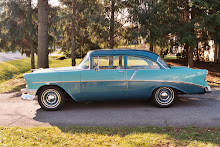
Confessions of a Drugstore Car Guy
By Carroll G Anderson
Winter’s coming and, this year, it seems it’s coming pretty darn fast . . . aren’t we supposed to get some Fall before it gets too cold and nasty? This time of year I start thinking about “the Season” back home in Arizona. Out there you cruise and attend car shows in the winter when it’s dry and cool. The rest of the year it’s dry and hot enough to barbeque on the tailgate, no grill required! Winter is also off-road season in the desert and that’s what’s tugging at my nostalgia strings right now.
My friends, family and I used to love off-roading although, truth be told, it was really “bad-roading.” While you can go just about anywhere you want in the desert, you’re supposed to drive where someone has already blazed the trail; it ain’t environmentally correct to scar up the desert. Wheel tracks tend to become permanent fixtures in that neck-of-the-woods. There are, however, plenty of existing tracks and ruts to follow and no reason to really of “off-road.”
There are lots and lots of four-wheel drive treks that will provide plenty of white-knuckled travel. I believe it’s both reasonable and prudent to utilize existing routes when exploring in the desert; it’s also wise to travel with at least one other vehicle. Several times in my four-wheeling career we found intrepid (that’s another term for stupid) off-roaders who headed out ill-equipped and on their own and wound-up stuck. Some of them might still be there if we hadn’t come along.
The following report illustrates the thrills and spills that are available in the desert, in the winter. My friend Clint told me the story as we were climbing Harquahala Peak in his new Jeep.
All’s Well That Endos Well
Several years ago my friend Clint and a couple of his motorcycle riding buddies entered the Barstow-Las Vegas race. Now, none of these guys are/were kids; suffice it to say they were riding in the Over-40 classes. They did all have a number of years and lots of desert riding experience under their belts, however. Clint, especially, knew how to prepare for a race and never started without everything he’d need, within reason.
One of the guys, Allen, had earned “points” from competing in a previous race so he got to start with the “pros.” Clint and the other buddy, Bob, were in the amateur class and got to start at the same time. In races like the B-LV, the classes start together several minutes apart so Allen was long gone by the time Clint and Bob’s group took off. They didn’t figure on seeing him until Vegas.
The B-LV race, billed as a 250 mile event is actually only 236 miles long. But even then it’s 4 ½ hours of the most diabolical terrain the promoters can get permission to traverse; and that’s for the fastest vehicles on the course. Clint and Bob planned on being on the trail a lot longer than that! For the unititiated, 6 or 8 hours of bone-jarring rocks and whoop-de-doos at WFO is deliberately no walk in the park. If it wasn’t so much fun (in the minds of the kind of people who actually like that sort of thing) it would be considered unconstitutionally cruel and unusual punishment.
As stated earlier, the course for an event like the B-LV 250 is deliberately as difficult as the promoters can make it. In desert racing that means rocky hills, soft sand washes, and washboard terrain called whoop-de-doos, or whoops. There is a mad science in the development of whoops, too. They have to have a certain interval between peaks and valleys or they’re too easy. Riders quickly figure out how fast they have to go to jump from the upside of one whoop to the downside of the next. Or how slow they can go just to float over them. A “good” course, of course, features whoops with all sorts of intervals so that rhythm is much harder to achieve. In any case, riding whoops is like one kick in the ass after another, ad naseum. Couple that with steep hills covered with loose rocks and washes with really deep, shifty sand and you’ve pretty much defined the B-LV race experience.
Clint keeps himself in pretty good shape and, considering the nature of the course, wasn’t having too hard a time in the first leg of the race. Bob, however, wasn’t in good shape at all and was getting his ass kicked from the git-go. It wasn’t very long before he was suffering and his predicament was obvious to Clint, who slowed down to keep an eye on his buddy. At one point, on a hill that Bob simply wasn’t going to get up without help, Clint used the tow strap he carried to pull the other bike to the top. The hills, fighting sand in the washes, and the whoops had Bob on the ropes and the race had just gotten underway!
Fortunately, after the first checkpoint the course got somewhat easier and Bob was able to get his second wind. Seeing that his buddy was going to make it, at least on this stage, Clint concentrated on riding his own race. Now that he was on his own, Clint was able to log some miles WFO and started passing some bikes. Just as it looked like he might make up some of the time he lost helping Bob, however, Clint’s bike broke. Sitting there watching everyone go by, Clint figured at least Bob could tow him to the next checkpoint!
Sometime late, seeing Bob’s rotund form approaching, Clint picked his bike up. But Bob didn’t stop, didn’t look in Clint’s direction; he went by oblivious to the crippled bike and stranded rider. Didn’t see you, he later contended. After some fiddling, Clint was able to get his bike to keep running so at least he didn’t have to push while walking along beside it. How far could it be to the next checkpoint?
Turns out he never made it; not afoot, anyway. After walking the bike about a quarter mile, Clint came across another rider who’d had some bad luck; worse than Clint’s, it turned out. This guy was in pretty poor shape. He said he thought his collarbone was broken. He’d hit a rock and endo’d over the handlebars, landing hard on his right shoulder. On the bright side, he said, it looked like his bike was okay.
Clint asked him what he was going to do, that it would be later that night before they sent out people to look for casualties. On a course like this there wasn’t a parallel track for support vehicles to be able to reach downed riders. Unless there were injuries so severe that the event had to be shut down for a medevac, the wounded had to stay put until it was all over.
The guy, he said his name was Doug, told Clint he’d been riding with a group from his club, that they knew where he was, and that they’d be back for him as soon as they could. He asked Clint if he had any water and some asprin, that his canteen was about empty and his shoulder was starting to hurt.
Clint replied that he was nearly out of water, too, and he didn’t have any aspirin. What he did have was a bottle of brandy and some percodan and he’d gladly share those. Doug was welcome to some of each, if he thought they’d help.
Well, Doug was pretty sure they’d help; alone or, even better, together. In exchange, he offered his bike so Clint could continue the race.
Saturday, October 24, 2009

Sunday, March 29, 2009
‘Twas Spring Carlisle Saturday
‘Twas Spring Carlisle Saturday, in my wife’s SUV;
We’re five cooped-up car guys who yearn to be free.
With no car shows or cruise-ins and nothing to do,
We’ve been stuck in the house the long winter thru.
My buddys are buckled all snug in their places
With doughnuts and coffee and smiles on their faces.
We left real early to be the first thru the gate
And so I can find parking in the same state.
Out on the highway we pass car after car
Heading for Carlisle from near and from far.
They’re real car guys from the look on their faces
To start the new season, they’re off to the races.
Traffic’s light as we approach the fairground
And we a find parking space without driving around.
For only ten dollars we park on somebody’s lawn;
Toward car guy heaven we’re inexorably drawn.
Adrenaline kicks in as we walk thru the gates,
‘Cause we know up ahead that treasure awaits.
First stop, however, after the doughnuts and coffee,
Is getting in line for a much needed pee.
Old stuff and new stuff and good stuff and crap,
A cornucopia of car stuff for us is on tap.
We check every vendor, leave nothing to chance,
They’ve got tools from China, even used Levi pants.
When we’re hungry only something greasy will do
Like buns piled high with pork bar-b-que
Or fresh cut french fries or sausage and peppers;
A regular bonanza of tasty vein cloggers.
If your daughter’s boyfriend wants an old car
Something kinda retro that won’t take him too far
On Carlisle’s fairgrounds, you’ll find it all there,
Like a cute little Pinto or maybe Corvair
There’s acres and acres of all kinds of things
To tickle your fancy and loosen purse-strings
Cars parked side-by-side up and down a big hill
You’re sure to find something to give you a thrill.
To recapture my youth I seek a sixty-two Valiant
With a hyper-pak four-barrel slant six powerplant.
I can’t find one this year but my faith isn’t shaken
I know my dream Mopar will be here next season.
Carlisle’s not Scottsdale, it’s not Barrett-Jackson
But they do have the Spring Collector Car Auction
Under strict orders from home not even to try
I better not bid on anything, let alone buy.
We drool over good stuff at the Car Corral ramada,
Like a low mile sixty-three Super Sport Impala
Next to a fifty-nine Cadillac Coupe DeVille’s fins
And a set of sixty-seven Cobra replicar twins
After tromping the rows from A thru triple-Z
We’ve seen only a small part of what’s there to see.
With only time for a pit stop and a bottle of water;
It’s getting late and we have a long walk to the car.
Chevy guys or Ford guys or guys who love Mopars
All dream of finding neat stuff for our cars.
But If you’re serious or just killing time for a while,
Something for everyone’s to be found at Carlisle.
‘Twas Spring Carlisle Saturday, in my wife’s SUV;
We’re five cooped-up car guys who yearn to be free.
With no car shows or cruise-ins and nothing to do,
We’ve been stuck in the house the long winter thru.
My buddys are buckled all snug in their places
With doughnuts and coffee and smiles on their faces.
We left real early to be the first thru the gate
And so I can find parking in the same state.
Out on the highway we pass car after car
Heading for Carlisle from near and from far.
They’re real car guys from the look on their faces
To start the new season, they’re off to the races.
Traffic’s light as we approach the fairground
And we a find parking space without driving around.
For only ten dollars we park on somebody’s lawn;
Toward car guy heaven we’re inexorably drawn.
Adrenaline kicks in as we walk thru the gates,
‘Cause we know up ahead that treasure awaits.
First stop, however, after the doughnuts and coffee,
Is getting in line for a much needed pee.
Old stuff and new stuff and good stuff and crap,
A cornucopia of car stuff for us is on tap.
We check every vendor, leave nothing to chance,
They’ve got tools from China, even used Levi pants.
When we’re hungry only something greasy will do
Like buns piled high with pork bar-b-que
Or fresh cut french fries or sausage and peppers;
A regular bonanza of tasty vein cloggers.
If your daughter’s boyfriend wants an old car
Something kinda retro that won’t take him too far
On Carlisle’s fairgrounds, you’ll find it all there,
Like a cute little Pinto or maybe Corvair
There’s acres and acres of all kinds of things
To tickle your fancy and loosen purse-strings
Cars parked side-by-side up and down a big hill
You’re sure to find something to give you a thrill.
To recapture my youth I seek a sixty-two Valiant
With a hyper-pak four-barrel slant six powerplant.
I can’t find one this year but my faith isn’t shaken
I know my dream Mopar will be here next season.
Carlisle’s not Scottsdale, it’s not Barrett-Jackson
But they do have the Spring Collector Car Auction
Under strict orders from home not even to try
I better not bid on anything, let alone buy.
We drool over good stuff at the Car Corral ramada,
Like a low mile sixty-three Super Sport Impala
Next to a fifty-nine Cadillac Coupe DeVille’s fins
And a set of sixty-seven Cobra replicar twins
After tromping the rows from A thru triple-Z
We’ve seen only a small part of what’s there to see.
With only time for a pit stop and a bottle of water;
It’s getting late and we have a long walk to the car.
Chevy guys or Ford guys or guys who love Mopars
All dream of finding neat stuff for our cars.
But If you’re serious or just killing time for a while,
Something for everyone’s to be found at Carlisle.
Wednesday, January 28, 2009
Feedback to reprint of November post
Chevy Classics magazine reprinted the Confessions column I posted in November in their February 2009 issue. Since then the editor, Joe Whitaker, has received a number of responses whe he answered and e-mailed to me. That feedback follows:
Sent: Monday, January 12, 2009 11:54 PM Subject: Response to February 2009 Editorial
Mr. Joe Whitaker, Chevy Classics Magazine.
I was shocked to read the boat load of misinformation in Mr. Anderson’s editorial published in the February, 2009 issue. A Toyota the best selling car since 1966? Not even close. What it actually is the “nameplate” that that has the highest total Number of units sold due to it’s being in continuous production Since 1966. That took nine generations of a car that Toyota put the “Corolla” name on. Not the best selling car in every year since 1966. Also by his accounts the Corolla was “closely followed” By a Volkswagen! Wrong again, Mr. Anderson. The air cooled Beetle was produced from 1947-2003 or 56 YEARS to become The second largest automobile ever produced. It took until 1972 to Surpass the previous record holder, the Ford Model T. That does not make it the second best selling car since 1966.
Then Mr. Anderson calls the full size American pick up a “niche vehicle, At best”? Is he serious? GM and Ford sell almost half a million units a Year. EACH! Even Mr. Anderson’s beloved Toyota would kill for that Kind of niche. And oh, by the way, check and see how GM, Ford, and Dodge have been kicking the Toyota’s Tundra,s butt! The Ford F150 was the top selling name for 23 years in a row and the Best selling truck for 28 years in a row. Check Wiki Answers and you’ll see the information Mr. Anderson Has skewed to fit his editorial.
Think of it like this: Bel Air was a new nameplate in 1950. Chevrolet produced 1,520,577 cars that year. Say GM decided not to change that name since then, calling all full size Chevrolets Bel Air. Multiply that times 58 years of production and you’d have 88,193,466 Chevrolets called Bel Air. Would that make it the best selling car since 1950? No. It’s only the car bearing that name since 1950.
This is not to say that GM doesn’t have it’s problems. Far from it. I work for a GM dealer’s parts department. It’s difficult to keep the Customer’s happy, while dealing with GM’s convoluted systems. Over the Christmas holidays there were 12 days GM shipped no parts. How’s that for customer service! What is not needed is to distort information to make things worse. Please check this stuff out before it’s printed, OK?
David R. Robinson, 24249
Joe replied:
David,
Thanks for your viewpoint. As you admit, the facts can be interpreted however you wish to make your case. The fact remains that American new car buyers think that import cars are better cars than the US brands 2:1. The US automakers still have to fight that uphill battle of the perception established in the 1960’ that foreign cars are good quality and US cars are junk. Unfortunately, with the horrible cars we (the US) built in the 1970’s and 1980’s; we did nothing but reinforce the beliefs established in the previous decade.
The US manufacturers have a huge task ahead of them. Introducing to the world a car or cars that you are going to build (i.e.: the 2010? Camaro and the Volt) and then waiting 5+ years to do so takes credibility away from the manufacturers. By the time these cars are produced, the designs and ideas will appear older than a well worn shoe.
And price. GM brags about the Chevy Traverse starting at “only” $30K. Thirty grand for a middle of the road SUV? Good grief. What happened to our low priced three?
Joe Whitaker, Eckler's Classic Chevy
Sent: Thursday, January 15, 2009 6:08 PM Subject: Response to editorial
I must say I'm absolutely furious after reading you article on pg 4 of the feb 09 issue about GM. I am so tired of ignorant people who have no clue as to the facts, running off at the mouth. I have worked for GM for 32 years I hired in when I was 18 years old.( I now live with chronic back pain 24 hours a day and have problems with both of my shoulders, i have had many dangerous jobs over the years and was exposed to many dangerous chemicals) so it pisses me off when people say you make too much money! oh by the way, we have lost so much of our health care benefits that a person on Medicaid has better healthcare!, .The article makes mention that the B3 union wages are 50% higher than the transplants, (Bullshit!!, our wages are within $ 4.00 of what they pay and some cases they make more than we do. The new hires at the B3 are hired in at $14.00 an hour with very little benefits.Yes there have been problems, but our quality is as good as and most cases is better than the foreign transplants! We have become alot leaner company in the last few years.The article goes on to say we are on the brink of collapse, yes things are bad but we still sold more cars than the transplants., but when the economy tanked and people stopped buying cars money got tight, take a look at the sales numbers for the transplants they were worse than GM's. Please go out to the UAW website and get the straight facts. I have been a member of classic chevy for 20 years and i was about to cancel my subscription after reading this bullshit! I will also be emailing this idiot Carroll G Anderson and setting her ignorant ass straight!
Rick Hammons, #10083831
Joe replied:
Rick,
Thanks for your viewpoint. I am sure that as a GM employee, your view of things is far different from those of us that are consumers. It may interest you to know that I am an avid GM buyer, and have only ever bought GM (Chevrolet) products new. I can personally say there are 10+ individuals that I have converted from “transplants” by convincing them of the quality of Gm products and being able to offer them GMS pricing thru the friends I have made at The Tech Center. My parents, who used to be Volkswagen and Mercedes buyers, were converted to Chevy in 1986 by me. They have purchased nothing but Chevrolet since and just recently bought a 2009 Impala. Just this week they drove that car from KY to FL and were excited to report that they got 31 miles per gallon on the trip.
However, the fact remains that American new car buyers think that import cars are better cars than the US brands 2:1. The US automakers still have to fight that uphill battle of the perception established in the 1960’s that foreign cars are good quality and US cars are junk. Unfortunately, with the horrible cars we (the US) built in the 1970’s and 1980’s; we did nothing but reinforce the beliefs established in the previous decade.
The US manufacturers have a huge task ahead of them. Introducing to the world a car or cars that you are going to build (i.e.: the 2010? Camaro and the Volt) and then waiting 5+ years to do so takes credibility away from the manufacturers. By the time these cars are produced, the designs and ideas will appear older than a well worn shoe.
And price. GM brags about the Chevy Traverse starting at “only” $30K. Thirty grand for a middle of the road SUV? Good grief. What happened to our low priced three?
Joe Whitaker, Eckler's Classic Chevy
Joe wrote to me on1/19/09:
I'm glad we have people cranked up! It is interesting that of the 10 or so calls and emails I have received, 100% are either auto workers or union employees of some other large manufacturer. Drinking that Kool Aid I guess..... Joe Whitaker, Eckler's Classic Chevy
Sent: Friday, January 16, 2009 10:19 PM Subject: From the Driver's Seat column, February 2009
Please make sure this letter gets to Mr Joe Whitaker. Thank you very much.
Letter to the Editor, Mr Joe Whitaker
Joe,
I was a bit disturbed and disappointed in your column in the February 2009 issue. You stated, "...that''s exactly how I would have written it", but as I read the article all I could think of is, "that's exactly the opposite of how I would have written it and exactly the opposite of what we need to do to help America at this time".
I am an absolute car nut and live and breath cars in every aspect of my life. I work in Detroit for one of the Big Three, restore Chevrolet's as a hobby, and make some side fun-money doing automotive repairs and restorations for other local enthusiasts. I appreciate the comments of Carroll G. Anderson but a few facts do need to be corrected. He states, "Since 1966, the best selling car has been a Toyota followed closely by Volkswagon." Nothing could be further from the truth. Yes, a Toyota has held the top spot for a few years, but the Taurus, and even an Oldsmobile held the spot as recent as 1987. Volkswagon sales in the US are nowhere near the top of the ladder and surely they have never been even close to the best selling car in the US. I won't bore anyone with the exact details of every year since 1966, but that info is readily available on the Internet with a few key punches by anyone interested. The top selling VEHICLE has been the Ford F150 which outsells the Toyota contingent by far! That spot has been held by the F150 for many decades!
Instead of the article reflecting on the poor management decisions or the poor product offerings of the PAST, I would have applauded one that had a flavor like this... We all have heard the story of that diesel Oldsmobile, or that rusty Chrysler or that Fixed or Repaired Daily Ford, but isn't it about time to give the Big 3 the chance that they need to prove their current worth. As car enthusiasts from a time when American cars truly ruled the road, can't we start the trend and show the world how great the new Malibu is, or how smooth the new Impala is, or how innovative a rear wheel drive sedan like the Chrysler 300M with the legendary Hemi is? Have you seen the offerings from Buick lately? Have you driven any of the new Saturns? Have you smoked the tires in a new Challenger or Charger? How about the Supercharged Mustangs? Do you know that Ford has better quality than Toyota? Do you know Chrysler had the least number of recalls last year of ANY automaker?
Personally I will put any of the Big 3's vehicles up against anything offered from Japan, Korea, Germany, or Bavaria. The facts will show you that we compete in Quality, Fuel Economy, Safety, and Cost. It's about time that some of our media outlets, including car clubs like this one, support the Big 3 and show the positive side of the story. I welcome anyone reading this to the motor city to tour our engineering facility, engine plant, and vehicle assembly plants. I'll convert you back to American Iron one person at a time.
Jeff Betz
Joe Replied:
Thanks Jeff, this is exactly the kind of dialouge we hoped to encourage. With your permission, I will print this in "Letters To The Editor". Take care!
Joe Whitaker, Eckler's Classic Chevy
Sent: Thursday, January 15, 2009 11:18 PM Subject: February 2009 Driver's Seat
Dear Joe:
As a CCI member for many years I was very surprised and disappointed to read your February Driver's Seat Column. I realize that you didn't write the piece but your forword indicated agreement with the author. As a car guy I would expect you to have a little better perspective on the request of the big three for bridge loan financing. You notice I said bridge loan and not bailout. The auto companies have only asked Congress for guaranteed bridge loans. It may have escaped your notice but the foreign car manufacturers are experiencing a radical drop in new car sales as well.
I believe that two factors are primarily to blame for this slowdown. The first was the rapidly escalating price of gasoline in the U.S. Having gone from a dollar a gallon to nearly five dollars a gallon inside of a couple of years has put a huge strain on the average household budget in this country. This enormous increase in fuel cost left little money for discretionary spending for new cars and trucks.
The second cause I believe was the collapsing economy and loss of jobs in this country. I am always fascinated by those who, when a business gets in trouble, immediately want to blame the employees if they have a Union contract. We pay lip service in this country to wanting our citizens to get good jobs with good pay and benfit packages for their family. But when it comes down to it what we mean is we want those things for us not for them.
By them I mean people other than ourselves. Well, here's the problem, they are us and we are them. The auto industry has some of the few good manufacturing jobs left in this country. But we want to blame the problems of the big three on the workers because the foreign auto manufacturers are paying less. Why? Because they have carefully selected areas of this country to build their plants where jobs were scarce and the state and local governments would give them tax breaks and huge incentives to locate there.
It is easy to say that the big three have built big cars that guzzle gas and ignored the economy cars. Well that's not exactly true either. They built the economy cars but we found them uninspiring. When I say we I mean especially we the classic car enthusiasts. We wanted the big SUVs, the full sized trucks and they delivered. They delivered so well that they had Toyota and Nissan falling all over themselves to build bigger tougher trucks to compete with GM, Ford and Dodge. But guess what? The Chevy trucks got better gas milage than the Toyota and Nissan full sized trucks. The trouble is that when gas get up over four dollars per gallon and you pull your truck in to fill up and a hundred dollar bill doesn't fill the tank you got trouble. I don't know about you but I am just as guilty of this as anyone.
I should also mention that while these evil auto workers were earning fair wages and benefits states like Alabama were giving huge money to foreign competition to locate their plants there, non-union of course. In fact Motor Trend Magazine reported that State governments have given $3.2 billion in incentives and subsidies to foreign auto makers. Factor in the tarriffs imposed upon U.S. auto imports to foreign countries while the U.S. removes import tarriffs in the name of free trade and you have a situation guaranteed to have the big three wringing their hands. Our corporations have been so busy exporting our jobs to other countries that it's a wonder that anyone has a job other than making hamburgers. Simple logic tells me that we can't just be consumers, we must also be workers. If we are going to buy foreign products someone needs to buy our products. So let's lighten up a little on the big three and their work force.
Rich Zell,Novato, California
Joe Replied:
Rich,
Thanks for your viewpoint. There are many different ways to interpret the facts about U.S. built vs. import new car sales. To address your specific issues; I think we Americans have had about enough taxpayer subsidies of businesses in trouble, don't you? I am a free-market guy at heart and firmly believe that the free market should be allowed to determine which businesses survive and which do not. Granted all may not be 100% fair with foreign government subsidies of their carmakers and incentives by states and cities to encourage foreign car makers to come here and build their cars, but what are those states and cities to do?
There are not too many U.S. car makers offering to build plants in states other than those where they have been for years. This is obviously a function of sales. U.S. cars have not been in increaseddemand, so no need for new plants. The foreign cars are in increased demand so the makers realize the need for quality labor and reduced transportation costs.
However, the fact remains that American new car buyers think that import cars are better cars than the US brands 2:1. The US automakers still have to fight that uphill battle of the perception established in the 1960's that foreign cars are good quality and US cars are junk. Unfortunately, with the horrible cars we (the US) built in the 1970's and 1980's; we did nothing but reinforce the beliefs established in the previous decade.
It may interest you to know that I am an avid GM buyer, and have only ever bought GM (Chevrolet) products new. I can personally say there are 10+ individuals that I have converted from foreign cars by convincing them of the quality of GM products and being able to offer them GMS pricing thru the friends I have made at The Tech Center. My parents, who used to be Volkswagen and Mercedes buyers, were converted to Chevy in 1986 by me. They have purchased nothing but Chevrolet since and just recently bought a 2009 Impala. Just this week they drove that car from KY to FL and were excited to report that they got 31 miles per gallon on the trip. Carroll's editorial in no way attacks the autoworker. If you read it carefully, he correctly blames the manufacturer and the unions for continuing to negotiate unrealistic contracts in a time of globalcompetition. The US manufacturers have a huge task ahead of them. Introducing to the world a car or cars that you are going to build (i.e.: the 2010? Camaro and the Volt) and then waiting 5+ years to do so takes credibility away from the manufacturers. By the time these cars are produced, the designsand ideas will appear older than a well worn shoe.Joe Whitaker, Eckler's Classic Chevy
Sent: Monday, January 12, 2009 11:54 PM Subject: Response to February 2009 Editorial
Mr. Joe Whitaker, Chevy Classics Magazine.
I was shocked to read the boat load of misinformation in Mr. Anderson’s editorial published in the February, 2009 issue. A Toyota the best selling car since 1966? Not even close. What it actually is the “nameplate” that that has the highest total Number of units sold due to it’s being in continuous production Since 1966. That took nine generations of a car that Toyota put the “Corolla” name on. Not the best selling car in every year since 1966. Also by his accounts the Corolla was “closely followed” By a Volkswagen! Wrong again, Mr. Anderson. The air cooled Beetle was produced from 1947-2003 or 56 YEARS to become The second largest automobile ever produced. It took until 1972 to Surpass the previous record holder, the Ford Model T. That does not make it the second best selling car since 1966.
Then Mr. Anderson calls the full size American pick up a “niche vehicle, At best”? Is he serious? GM and Ford sell almost half a million units a Year. EACH! Even Mr. Anderson’s beloved Toyota would kill for that Kind of niche. And oh, by the way, check and see how GM, Ford, and Dodge have been kicking the Toyota’s Tundra,s butt! The Ford F150 was the top selling name for 23 years in a row and the Best selling truck for 28 years in a row. Check Wiki Answers and you’ll see the information Mr. Anderson Has skewed to fit his editorial.
Think of it like this: Bel Air was a new nameplate in 1950. Chevrolet produced 1,520,577 cars that year. Say GM decided not to change that name since then, calling all full size Chevrolets Bel Air. Multiply that times 58 years of production and you’d have 88,193,466 Chevrolets called Bel Air. Would that make it the best selling car since 1950? No. It’s only the car bearing that name since 1950.
This is not to say that GM doesn’t have it’s problems. Far from it. I work for a GM dealer’s parts department. It’s difficult to keep the Customer’s happy, while dealing with GM’s convoluted systems. Over the Christmas holidays there were 12 days GM shipped no parts. How’s that for customer service! What is not needed is to distort information to make things worse. Please check this stuff out before it’s printed, OK?
David R. Robinson, 24249
Joe replied:
David,
Thanks for your viewpoint. As you admit, the facts can be interpreted however you wish to make your case. The fact remains that American new car buyers think that import cars are better cars than the US brands 2:1. The US automakers still have to fight that uphill battle of the perception established in the 1960’ that foreign cars are good quality and US cars are junk. Unfortunately, with the horrible cars we (the US) built in the 1970’s and 1980’s; we did nothing but reinforce the beliefs established in the previous decade.
The US manufacturers have a huge task ahead of them. Introducing to the world a car or cars that you are going to build (i.e.: the 2010? Camaro and the Volt) and then waiting 5+ years to do so takes credibility away from the manufacturers. By the time these cars are produced, the designs and ideas will appear older than a well worn shoe.
And price. GM brags about the Chevy Traverse starting at “only” $30K. Thirty grand for a middle of the road SUV? Good grief. What happened to our low priced three?
Joe Whitaker, Eckler's Classic Chevy
Sent: Thursday, January 15, 2009 6:08 PM Subject: Response to editorial
I must say I'm absolutely furious after reading you article on pg 4 of the feb 09 issue about GM. I am so tired of ignorant people who have no clue as to the facts, running off at the mouth. I have worked for GM for 32 years I hired in when I was 18 years old.( I now live with chronic back pain 24 hours a day and have problems with both of my shoulders, i have had many dangerous jobs over the years and was exposed to many dangerous chemicals) so it pisses me off when people say you make too much money! oh by the way, we have lost so much of our health care benefits that a person on Medicaid has better healthcare!, .The article makes mention that the B3 union wages are 50% higher than the transplants, (Bullshit!!, our wages are within $ 4.00 of what they pay and some cases they make more than we do. The new hires at the B3 are hired in at $14.00 an hour with very little benefits.Yes there have been problems, but our quality is as good as and most cases is better than the foreign transplants! We have become alot leaner company in the last few years.The article goes on to say we are on the brink of collapse, yes things are bad but we still sold more cars than the transplants., but when the economy tanked and people stopped buying cars money got tight, take a look at the sales numbers for the transplants they were worse than GM's. Please go out to the UAW website and get the straight facts. I have been a member of classic chevy for 20 years and i was about to cancel my subscription after reading this bullshit! I will also be emailing this idiot Carroll G Anderson and setting her ignorant ass straight!
Rick Hammons, #10083831
Joe replied:
Rick,
Thanks for your viewpoint. I am sure that as a GM employee, your view of things is far different from those of us that are consumers. It may interest you to know that I am an avid GM buyer, and have only ever bought GM (Chevrolet) products new. I can personally say there are 10+ individuals that I have converted from “transplants” by convincing them of the quality of Gm products and being able to offer them GMS pricing thru the friends I have made at The Tech Center. My parents, who used to be Volkswagen and Mercedes buyers, were converted to Chevy in 1986 by me. They have purchased nothing but Chevrolet since and just recently bought a 2009 Impala. Just this week they drove that car from KY to FL and were excited to report that they got 31 miles per gallon on the trip.
However, the fact remains that American new car buyers think that import cars are better cars than the US brands 2:1. The US automakers still have to fight that uphill battle of the perception established in the 1960’s that foreign cars are good quality and US cars are junk. Unfortunately, with the horrible cars we (the US) built in the 1970’s and 1980’s; we did nothing but reinforce the beliefs established in the previous decade.
The US manufacturers have a huge task ahead of them. Introducing to the world a car or cars that you are going to build (i.e.: the 2010? Camaro and the Volt) and then waiting 5+ years to do so takes credibility away from the manufacturers. By the time these cars are produced, the designs and ideas will appear older than a well worn shoe.
And price. GM brags about the Chevy Traverse starting at “only” $30K. Thirty grand for a middle of the road SUV? Good grief. What happened to our low priced three?
Joe Whitaker, Eckler's Classic Chevy
Joe wrote to me on1/19/09:
I'm glad we have people cranked up! It is interesting that of the 10 or so calls and emails I have received, 100% are either auto workers or union employees of some other large manufacturer. Drinking that Kool Aid I guess..... Joe Whitaker, Eckler's Classic Chevy
Sent: Friday, January 16, 2009 10:19 PM Subject: From the Driver's Seat column, February 2009
Please make sure this letter gets to Mr Joe Whitaker. Thank you very much.
Letter to the Editor, Mr Joe Whitaker
Joe,
I was a bit disturbed and disappointed in your column in the February 2009 issue. You stated, "...that''s exactly how I would have written it", but as I read the article all I could think of is, "that's exactly the opposite of how I would have written it and exactly the opposite of what we need to do to help America at this time".
I am an absolute car nut and live and breath cars in every aspect of my life. I work in Detroit for one of the Big Three, restore Chevrolet's as a hobby, and make some side fun-money doing automotive repairs and restorations for other local enthusiasts. I appreciate the comments of Carroll G. Anderson but a few facts do need to be corrected. He states, "Since 1966, the best selling car has been a Toyota followed closely by Volkswagon." Nothing could be further from the truth. Yes, a Toyota has held the top spot for a few years, but the Taurus, and even an Oldsmobile held the spot as recent as 1987. Volkswagon sales in the US are nowhere near the top of the ladder and surely they have never been even close to the best selling car in the US. I won't bore anyone with the exact details of every year since 1966, but that info is readily available on the Internet with a few key punches by anyone interested. The top selling VEHICLE has been the Ford F150 which outsells the Toyota contingent by far! That spot has been held by the F150 for many decades!
Instead of the article reflecting on the poor management decisions or the poor product offerings of the PAST, I would have applauded one that had a flavor like this... We all have heard the story of that diesel Oldsmobile, or that rusty Chrysler or that Fixed or Repaired Daily Ford, but isn't it about time to give the Big 3 the chance that they need to prove their current worth. As car enthusiasts from a time when American cars truly ruled the road, can't we start the trend and show the world how great the new Malibu is, or how smooth the new Impala is, or how innovative a rear wheel drive sedan like the Chrysler 300M with the legendary Hemi is? Have you seen the offerings from Buick lately? Have you driven any of the new Saturns? Have you smoked the tires in a new Challenger or Charger? How about the Supercharged Mustangs? Do you know that Ford has better quality than Toyota? Do you know Chrysler had the least number of recalls last year of ANY automaker?
Personally I will put any of the Big 3's vehicles up against anything offered from Japan, Korea, Germany, or Bavaria. The facts will show you that we compete in Quality, Fuel Economy, Safety, and Cost. It's about time that some of our media outlets, including car clubs like this one, support the Big 3 and show the positive side of the story. I welcome anyone reading this to the motor city to tour our engineering facility, engine plant, and vehicle assembly plants. I'll convert you back to American Iron one person at a time.
Jeff Betz
Joe Replied:
Thanks Jeff, this is exactly the kind of dialouge we hoped to encourage. With your permission, I will print this in "Letters To The Editor". Take care!
Joe Whitaker, Eckler's Classic Chevy
Sent: Thursday, January 15, 2009 11:18 PM Subject: February 2009 Driver's Seat
Dear Joe:
As a CCI member for many years I was very surprised and disappointed to read your February Driver's Seat Column. I realize that you didn't write the piece but your forword indicated agreement with the author. As a car guy I would expect you to have a little better perspective on the request of the big three for bridge loan financing. You notice I said bridge loan and not bailout. The auto companies have only asked Congress for guaranteed bridge loans. It may have escaped your notice but the foreign car manufacturers are experiencing a radical drop in new car sales as well.
I believe that two factors are primarily to blame for this slowdown. The first was the rapidly escalating price of gasoline in the U.S. Having gone from a dollar a gallon to nearly five dollars a gallon inside of a couple of years has put a huge strain on the average household budget in this country. This enormous increase in fuel cost left little money for discretionary spending for new cars and trucks.
The second cause I believe was the collapsing economy and loss of jobs in this country. I am always fascinated by those who, when a business gets in trouble, immediately want to blame the employees if they have a Union contract. We pay lip service in this country to wanting our citizens to get good jobs with good pay and benfit packages for their family. But when it comes down to it what we mean is we want those things for us not for them.
By them I mean people other than ourselves. Well, here's the problem, they are us and we are them. The auto industry has some of the few good manufacturing jobs left in this country. But we want to blame the problems of the big three on the workers because the foreign auto manufacturers are paying less. Why? Because they have carefully selected areas of this country to build their plants where jobs were scarce and the state and local governments would give them tax breaks and huge incentives to locate there.
It is easy to say that the big three have built big cars that guzzle gas and ignored the economy cars. Well that's not exactly true either. They built the economy cars but we found them uninspiring. When I say we I mean especially we the classic car enthusiasts. We wanted the big SUVs, the full sized trucks and they delivered. They delivered so well that they had Toyota and Nissan falling all over themselves to build bigger tougher trucks to compete with GM, Ford and Dodge. But guess what? The Chevy trucks got better gas milage than the Toyota and Nissan full sized trucks. The trouble is that when gas get up over four dollars per gallon and you pull your truck in to fill up and a hundred dollar bill doesn't fill the tank you got trouble. I don't know about you but I am just as guilty of this as anyone.
I should also mention that while these evil auto workers were earning fair wages and benefits states like Alabama were giving huge money to foreign competition to locate their plants there, non-union of course. In fact Motor Trend Magazine reported that State governments have given $3.2 billion in incentives and subsidies to foreign auto makers. Factor in the tarriffs imposed upon U.S. auto imports to foreign countries while the U.S. removes import tarriffs in the name of free trade and you have a situation guaranteed to have the big three wringing their hands. Our corporations have been so busy exporting our jobs to other countries that it's a wonder that anyone has a job other than making hamburgers. Simple logic tells me that we can't just be consumers, we must also be workers. If we are going to buy foreign products someone needs to buy our products. So let's lighten up a little on the big three and their work force.
Rich Zell,Novato, California
Joe Replied:
Rich,
Thanks for your viewpoint. There are many different ways to interpret the facts about U.S. built vs. import new car sales. To address your specific issues; I think we Americans have had about enough taxpayer subsidies of businesses in trouble, don't you? I am a free-market guy at heart and firmly believe that the free market should be allowed to determine which businesses survive and which do not. Granted all may not be 100% fair with foreign government subsidies of their carmakers and incentives by states and cities to encourage foreign car makers to come here and build their cars, but what are those states and cities to do?
There are not too many U.S. car makers offering to build plants in states other than those where they have been for years. This is obviously a function of sales. U.S. cars have not been in increaseddemand, so no need for new plants. The foreign cars are in increased demand so the makers realize the need for quality labor and reduced transportation costs.
However, the fact remains that American new car buyers think that import cars are better cars than the US brands 2:1. The US automakers still have to fight that uphill battle of the perception established in the 1960's that foreign cars are good quality and US cars are junk. Unfortunately, with the horrible cars we (the US) built in the 1970's and 1980's; we did nothing but reinforce the beliefs established in the previous decade.
It may interest you to know that I am an avid GM buyer, and have only ever bought GM (Chevrolet) products new. I can personally say there are 10+ individuals that I have converted from foreign cars by convincing them of the quality of GM products and being able to offer them GMS pricing thru the friends I have made at The Tech Center. My parents, who used to be Volkswagen and Mercedes buyers, were converted to Chevy in 1986 by me. They have purchased nothing but Chevrolet since and just recently bought a 2009 Impala. Just this week they drove that car from KY to FL and were excited to report that they got 31 miles per gallon on the trip. Carroll's editorial in no way attacks the autoworker. If you read it carefully, he correctly blames the manufacturer and the unions for continuing to negotiate unrealistic contracts in a time of globalcompetition. The US manufacturers have a huge task ahead of them. Introducing to the world a car or cars that you are going to build (i.e.: the 2010? Camaro and the Volt) and then waiting 5+ years to do so takes credibility away from the manufacturers. By the time these cars are produced, the designsand ideas will appear older than a well worn shoe.Joe Whitaker, Eckler's Classic Chevy
Tuesday, December 16, 2008
From the Confessions Archive, Oct. '05
I’ve been thinking about how much has changed since 1956, the year my Chevy was new. That was the year I stacked a bunch of boxes on top of my Western Flyer, climbed atop the boxes, and coasted down our street. The street was really steep and, if I’d made it to the bottom of the hill, I’d have been right smack in the middle of the busiest intersection in town! I didn’t make it to the bottom; I didn’t even make it as far as our house. The wagon swerved into the curb and launched me and the rest of the load into a ditch. I don’t remember if the wagon was hurt, or the boxes, but I broke my arm. I’d like to think I’ve gotten a little smarter in the fifty years since then!
Something that surprises me about change is how much things remain the same in the midst of it. Folks in the fifties figured we’d all be getting around by personal jet-pack a half a century in the future. Or, at the very least, in personal transportation modules that would whisk us wherever by voice command, automatically avoiding hazards and zooming around obstacles. Nope, cars still need the same kind of driver input they needed in ’56. That’s good, I’m not sure I’m up for flying around in a jet-pack and I sure don’t want to trust myself to some auto-pilot thingie on 270!
For the most part I think things have gotten better in the last fifty years. It’s easier to get things and there are a lot more things to get. Although stuff is a lot more expensive, in a lot of ways it’s more affordable. As expensive as houses, cars, most stuff, is, we have a lot more and have less trouble getting it. We certainly must have a lot more money to spend.
Today we shop online for many things, never leaving the comfort of our PC. Many of us carry our phone everywhere we go and some never put it down. We know what’s happening anywhere in the world, as it’s happening. We hop a plane and fly across the country or around the world as readily as folks in ’56 took a bus across town.
Many, most, things are a lot better today than they were in 1956. Although my car is still on the road and in pretty good shape, it spent most of its life parked in a garage. Today’s cars, at least the mechanical parts, have a much longer life expectancy. They don’t even need tune-ups for 100,000 miles! They get good gas mileage, perform better and they have better paint jobs. On the down side, periodic maintenance on some new cars costs more than some cars cost new in 1956; and need someone with a degree in computer science to work on them.
I don’t know if I like many of the things we have today that folks didn’t have in 1956, things I mention above. But I do know I’m damn sure glad I’ve got them and would really think I was in trouble if I didn’t have them.
Something that surprises me about change is how much things remain the same in the midst of it. Folks in the fifties figured we’d all be getting around by personal jet-pack a half a century in the future. Or, at the very least, in personal transportation modules that would whisk us wherever by voice command, automatically avoiding hazards and zooming around obstacles. Nope, cars still need the same kind of driver input they needed in ’56. That’s good, I’m not sure I’m up for flying around in a jet-pack and I sure don’t want to trust myself to some auto-pilot thingie on 270!
For the most part I think things have gotten better in the last fifty years. It’s easier to get things and there are a lot more things to get. Although stuff is a lot more expensive, in a lot of ways it’s more affordable. As expensive as houses, cars, most stuff, is, we have a lot more and have less trouble getting it. We certainly must have a lot more money to spend.
Today we shop online for many things, never leaving the comfort of our PC. Many of us carry our phone everywhere we go and some never put it down. We know what’s happening anywhere in the world, as it’s happening. We hop a plane and fly across the country or around the world as readily as folks in ’56 took a bus across town.
Many, most, things are a lot better today than they were in 1956. Although my car is still on the road and in pretty good shape, it spent most of its life parked in a garage. Today’s cars, at least the mechanical parts, have a much longer life expectancy. They don’t even need tune-ups for 100,000 miles! They get good gas mileage, perform better and they have better paint jobs. On the down side, periodic maintenance on some new cars costs more than some cars cost new in 1956; and need someone with a degree in computer science to work on them.
I don’t know if I like many of the things we have today that folks didn’t have in 1956, things I mention above. But I do know I’m damn sure glad I’ve got them and would really think I was in trouble if I didn’t have them.
Wednesday, November 26, 2008
Keeping The Gremlins At Bay
Although it seems a bit early this year; it’s the day before Thanksgiving, winter’s here and I’m already suffering from the twin winter-time gremlins of boredom and grouchiness. During the rest of the year I can usually find something to do to take my mind off annoying things that lead to the twins. In winter annoying things gang-up on me and I start driving me and anyone unfortunate enough to be stuck near me crazy. I have started cataloging annoying things in an effort to, hopefully, neutralize the gremlins.
We all know what lackeys are, right? Back in the day we’d call the lackeys of big shot bureaucrats, “horse-holders.” I have noticed lately there is a whole new class of horse-holder out there; although they don’t usually work for bureaucrats. They’re “hat handers,” the guy who hands the star (athlete, driver, whomever) the sponsor’s logo-bearing baseball cap(s). Just another opportunity to go-fer a celebrity!
Speaking of which; how demeaning are those sponsor’s logo-bearing baseball caps anyway? Imagine you just drove to victory in the Indianapolis 500, you’re standing on the podium to receive your justly deserved accolades but, before you can hold your latest trophy, you have to change hats six times. And make sure the logo on each, and on the beverage you’re consuming, is pointing camera-ward. It’s not like you didn’t just drive, on camera, 500 miles in a rolling billboard covered with the same logos.
Years ago I wrote a poem about how to successfully become an anonymous bureaucrat, something for which all bureaucrats strive:
The Bureaucrat
He dreams of having an office
And a telephone all of his own,
With a machine to answer it quickly
So the damn thing will leave him alone.
With all the pressure he’s under,
The stress and anxiety and such,
Each day brings another big crisis;
Just doing his job’s way too much.
Making those routine decisions
Is the most difficult thing that he does;
About a thousand and one stupid issues
To which he can’t say, “Just because. . .”
The answer he’ll give to your question
Will never be right or be wrong;
“I’m sorry,” he’ll say, “you’re mistaken
This isn’t where you belong.”
“Whatever you want we can’t help you
In this department at all;
For that you must go to the office,
Third door on the right, down the hall.”
For him no problem’s too difficult,
No question ever too trivial,
To refer to the office just mentioned;
Third door on the right, down the hall!
I recently re-read the poem and realized how obsolete it had become. When I wrote it I worked in an office where employees shared telephones; they were located in centralized “phone banks.” The phones, not the employees; they were located in cubicles. Nowadays everyone has a phone, and a computer, and any number of other devices to insure both anonymity and non-contactability.
Today, of course, there’s the phone menu. You know, “press 1 for . . . ad nauseum.” A system far more effective than even Beijing’s Forbidden City for eliminating unwanted attention. Talk about insulation; today’s bureaucrat can count on the phone menu, voice mail, e-mail, and security guards with metal detectors to keep the “customers” at bay! The personal computer and the receptionist rendered the secretary obsolete; soon all we’ll need is “virtual” bureaucrats. Who’ll know the difference?
Carroll G. Anderson
We all know what lackeys are, right? Back in the day we’d call the lackeys of big shot bureaucrats, “horse-holders.” I have noticed lately there is a whole new class of horse-holder out there; although they don’t usually work for bureaucrats. They’re “hat handers,” the guy who hands the star (athlete, driver, whomever) the sponsor’s logo-bearing baseball cap(s). Just another opportunity to go-fer a celebrity!
Speaking of which; how demeaning are those sponsor’s logo-bearing baseball caps anyway? Imagine you just drove to victory in the Indianapolis 500, you’re standing on the podium to receive your justly deserved accolades but, before you can hold your latest trophy, you have to change hats six times. And make sure the logo on each, and on the beverage you’re consuming, is pointing camera-ward. It’s not like you didn’t just drive, on camera, 500 miles in a rolling billboard covered with the same logos.
Years ago I wrote a poem about how to successfully become an anonymous bureaucrat, something for which all bureaucrats strive:
The Bureaucrat
He dreams of having an office
And a telephone all of his own,
With a machine to answer it quickly
So the damn thing will leave him alone.
With all the pressure he’s under,
The stress and anxiety and such,
Each day brings another big crisis;
Just doing his job’s way too much.
Making those routine decisions
Is the most difficult thing that he does;
About a thousand and one stupid issues
To which he can’t say, “Just because. . .”
The answer he’ll give to your question
Will never be right or be wrong;
“I’m sorry,” he’ll say, “you’re mistaken
This isn’t where you belong.”
“Whatever you want we can’t help you
In this department at all;
For that you must go to the office,
Third door on the right, down the hall.”
For him no problem’s too difficult,
No question ever too trivial,
To refer to the office just mentioned;
Third door on the right, down the hall!
I recently re-read the poem and realized how obsolete it had become. When I wrote it I worked in an office where employees shared telephones; they were located in centralized “phone banks.” The phones, not the employees; they were located in cubicles. Nowadays everyone has a phone, and a computer, and any number of other devices to insure both anonymity and non-contactability.
Today, of course, there’s the phone menu. You know, “press 1 for . . . ad nauseum.” A system far more effective than even Beijing’s Forbidden City for eliminating unwanted attention. Talk about insulation; today’s bureaucrat can count on the phone menu, voice mail, e-mail, and security guards with metal detectors to keep the “customers” at bay! The personal computer and the receptionist rendered the secretary obsolete; soon all we’ll need is “virtual” bureaucrats. Who’ll know the difference?
Carroll G. Anderson
Monday, November 24, 2008
Confessions of a Drug Store Car Guy, Nov., '08
It’s hard being a member of a “classic chevy club” and not be concerned about the future of General Motors and those other two car companies. I was born sixty-some years ago and “the big three” (B3) were the big dogs in both American industry and the American economy. In those days they shared the spotlight with biggies in the steel industry and retail giants like Sears-Roebuck. Although quite a few of the companies on the NY Stock Exchange today were there fifty years ago, some are gone (the steel industry and retail giants like Sears-Roebuck) and those that remain have transformed themselves to meet the realities of a new century and a new economy. All except the B3, apparently.
Despite the persistent ringing of their alarms, the B3 seem to insist on hitting the snooze button. How obvious was the wake-up call from Japanese and European automakers every year since the 1960s? Since 1966 the best selling car has been a Toyota followed closely by a Volkswagen. With the exception of the Ford F-150, Mustang and Corvette, niche vehicles at best, the top selling cars for over forty years were built by someone other than the B3. If the reason why American cars have under-performed in the marketplace was a mystery the lack of response on the part of the B3 might be understandable. But there is no mystery, buyers know they get better value buying “foreign” cars!
Today we’re told the B3 are on the verge of collapse and that they need to be bailed-out or they’ll fail and drag the rest of the economy with them. The debate rages; bail-out or bankrupcy and there is plenty of support for either side. I’m a car guy not an economist and, therefore, not qualified to make the decision as to which course should be taken. Following the course they have over the sixty-some years I’ve been around, however, is not working for the B3 and it seems to me the problem is accounting, not economics.
The basis for accounting is balance; matching expenditures to revenue or not spending more than you make. The B3 have not operated within this accounting paradigm in decades. No component of the cost of “building a car” is more out of balance than labor costs (wages and benefits). The B3 are unionized and they pay their employees nearly 50% more than companies like Toyota and Honda pay their employees who build cars in the United States. A drive across Michigan reveals acres of new vehicles in abandoned parking lots, cars that were built in excess of demand because the B3 were required to pay union auto workers whether the cars were needed or not. When airlines started folding under the pressure of expensive labor contracts they re-negotiated those contracts and managed to survive and fly another day.
I don’t have the credentials to propose a solution to the crisis facing the B3 and I wouldn’t want the responsibility to do so if I was qualified. I am conscious, however, which may be more than can be said of the powers-that-be at either the B3 or the United Auto Workers. Albert Einstein said insanity is doing the same thing over and over again and expecting a different result. I believe insanity ought to be ample justification for throwing out the fools who have been running the B3 for decades. They didn’t fix things when it became obvious things were broken in the Seventies and there’s no reason to believe they’ll fix them now!
Carroll G. Anderson
From: Heart of Maryland Classic Chevy Club Holiday 2008 Newsletter
Despite the persistent ringing of their alarms, the B3 seem to insist on hitting the snooze button. How obvious was the wake-up call from Japanese and European automakers every year since the 1960s? Since 1966 the best selling car has been a Toyota followed closely by a Volkswagen. With the exception of the Ford F-150, Mustang and Corvette, niche vehicles at best, the top selling cars for over forty years were built by someone other than the B3. If the reason why American cars have under-performed in the marketplace was a mystery the lack of response on the part of the B3 might be understandable. But there is no mystery, buyers know they get better value buying “foreign” cars!
Today we’re told the B3 are on the verge of collapse and that they need to be bailed-out or they’ll fail and drag the rest of the economy with them. The debate rages; bail-out or bankrupcy and there is plenty of support for either side. I’m a car guy not an economist and, therefore, not qualified to make the decision as to which course should be taken. Following the course they have over the sixty-some years I’ve been around, however, is not working for the B3 and it seems to me the problem is accounting, not economics.
The basis for accounting is balance; matching expenditures to revenue or not spending more than you make. The B3 have not operated within this accounting paradigm in decades. No component of the cost of “building a car” is more out of balance than labor costs (wages and benefits). The B3 are unionized and they pay their employees nearly 50% more than companies like Toyota and Honda pay their employees who build cars in the United States. A drive across Michigan reveals acres of new vehicles in abandoned parking lots, cars that were built in excess of demand because the B3 were required to pay union auto workers whether the cars were needed or not. When airlines started folding under the pressure of expensive labor contracts they re-negotiated those contracts and managed to survive and fly another day.
I don’t have the credentials to propose a solution to the crisis facing the B3 and I wouldn’t want the responsibility to do so if I was qualified. I am conscious, however, which may be more than can be said of the powers-that-be at either the B3 or the United Auto Workers. Albert Einstein said insanity is doing the same thing over and over again and expecting a different result. I believe insanity ought to be ample justification for throwing out the fools who have been running the B3 for decades. They didn’t fix things when it became obvious things were broken in the Seventies and there’s no reason to believe they’ll fix them now!
Carroll G. Anderson
From: Heart of Maryland Classic Chevy Club Holiday 2008 Newsletter
Friday, November 7, 2008
Confessions of a Drugstore Car Guy, Oct. '08
I don’t stockpile these “Confessions”; each month I think until I come up with an idea I can run with. Sometimes the ideas are kinda lame. I know even Brett Farve can’t throw for a touchdown every time so I guess the best I can hope for is to not get sacked too often. Enough of the pitiful attempts at metaphor, this month I’m thinking about what we do and why.
By we, I mean HMCCC, individually and as a club. We’re pretty lucky, you know, in that most of us are able to do the things we love; we have both the time and the money to pursue our passions at least to some extent. I remember the days when just the pressure of providing for a family kept me scrambling 24/7. There wasn’t time or money for unessentials and lots of “like-tos” took a backseat to “have-tos.”
It warms the cockles of my Loman & Barkley heart* when I see “us” doing the things we love to do and, at the same time, giving back to our community. Although it’s pretty obvious we don’t all love exactly the same things and sometimes don’t agree on how to show our love, we seem to agree on the “giving back” part. As a result, this year both the Alzheimer’s Association and Toys 4 Tots will be better able to do what they do. Everybody wins and that’s a good feeling!
I said last month that as long as I can cruise in my old car I don’t care too much about “economy crashes or hurricane breezes.” The fact is, in the coming months, some of us won’t be able to play with our toys to the extent we have in the past. Of course we’ll only have to wait until the new administration makes good on their promises. Then we’ll all wind up with a new Chevy in every garage and a new garage for every Chevy!
As good as our generosity makes me feel and as well as we seem to be able to overlook those things our colleagues do to annoy us, there is room for improvement. That’s what I thought the other night as I overheard one of my compatriots essentially telling another that “ . . . your cars aren’t as worthy of attention as mine.” I’d like to think that no Car Guy hates any other Car Guy because he (or she) loves his (her) car(s) too much (or not enough). We are in deep doo-doo if we start judging one-another on the amount of money we spend or the way we choose to make our cars look!
I happen to know that not too long ago one of our favorite Chevy guys attended an event celebrating . . . (wait for it) . . . Hemis! We certainly live in turbulent times. Nowhere is this more evident than in the auto industry. In fact, in the near future our favorite automaker may be changing its name; it’s possible we’ll soon be buying cars from General Mopars!
I don’t want to sound too P.C. here but I believe the strength of our association lies in its diversity; we share an appreciation of things automotive and the opportunity to interact with others who feel the same. We need to cultivate our differences, however, as much as we do our similarities. I, for one, will never support any mistreatment of either Ford owners or folks who trailer their old cars even though being around that kind of people makes me extremely uncomfortable.
*An obscure reference to the ‘70’s morning radio show on KFI, Los Angeles.
Shoeboxes in a Parking Lot
To the tune of Little Boxes
Shoeboxes in a parking lot,
All lined-up for another show,
Tri-five Chevys shined-up pretty,
And they don’t all look the same.
There's slammed ones and fast ones
And plain ones and fancy ones
All built by Chevy in the fifties,
But they’re just not all the same.
They are hot rods or customs,
Or restored to mint condition,
Though they all are Tri-five Chevys,
They are not just all the same.
There's convertibles and hardtops
And gassers and just survivors
Built by Chevy in the fifties
But they’re just not all the same.
Car Guys drive the shoeboxes
To shows and to cruise-ins,
And love their trusty Chevys,
Making sure they’re not the same.
There are Bel Airs and Nomads
And even some pick-up trucks,
Built by Chevy in the fifties
But they’re just not all the same.
With big blocks and small blocks,
And four-speeds and automatics
Some are trailer queens, others drivers
So they’re clearly not the same.
They come out in the spring time
And cruise on through the summer,
Then go back into their garages
Which are also not all the same.
I’ve been watching old episodes of a Showtime series called Weeds. The theme song of the show is Little Boxes which I remember from the Sixties. I think Pete Seeger sang the version I remember although it may have been written by Woodie Guthrie. It’s one of those songs you can’t get out of your head. Anyway, I modified it a bit to fit in this space (there’s a rumor going around that I may have too much time on my hands).
By C.G. Anderson
From: Heart of Maryland Classic Chevy Club Newsletter
October, 2008
By we, I mean HMCCC, individually and as a club. We’re pretty lucky, you know, in that most of us are able to do the things we love; we have both the time and the money to pursue our passions at least to some extent. I remember the days when just the pressure of providing for a family kept me scrambling 24/7. There wasn’t time or money for unessentials and lots of “like-tos” took a backseat to “have-tos.”
It warms the cockles of my Loman & Barkley heart* when I see “us” doing the things we love to do and, at the same time, giving back to our community. Although it’s pretty obvious we don’t all love exactly the same things and sometimes don’t agree on how to show our love, we seem to agree on the “giving back” part. As a result, this year both the Alzheimer’s Association and Toys 4 Tots will be better able to do what they do. Everybody wins and that’s a good feeling!
I said last month that as long as I can cruise in my old car I don’t care too much about “economy crashes or hurricane breezes.” The fact is, in the coming months, some of us won’t be able to play with our toys to the extent we have in the past. Of course we’ll only have to wait until the new administration makes good on their promises. Then we’ll all wind up with a new Chevy in every garage and a new garage for every Chevy!
As good as our generosity makes me feel and as well as we seem to be able to overlook those things our colleagues do to annoy us, there is room for improvement. That’s what I thought the other night as I overheard one of my compatriots essentially telling another that “ . . . your cars aren’t as worthy of attention as mine.” I’d like to think that no Car Guy hates any other Car Guy because he (or she) loves his (her) car(s) too much (or not enough). We are in deep doo-doo if we start judging one-another on the amount of money we spend or the way we choose to make our cars look!
I happen to know that not too long ago one of our favorite Chevy guys attended an event celebrating . . . (wait for it) . . . Hemis! We certainly live in turbulent times. Nowhere is this more evident than in the auto industry. In fact, in the near future our favorite automaker may be changing its name; it’s possible we’ll soon be buying cars from General Mopars!
I don’t want to sound too P.C. here but I believe the strength of our association lies in its diversity; we share an appreciation of things automotive and the opportunity to interact with others who feel the same. We need to cultivate our differences, however, as much as we do our similarities. I, for one, will never support any mistreatment of either Ford owners or folks who trailer their old cars even though being around that kind of people makes me extremely uncomfortable.
*An obscure reference to the ‘70’s morning radio show on KFI, Los Angeles.
Shoeboxes in a Parking Lot
To the tune of Little Boxes
Shoeboxes in a parking lot,
All lined-up for another show,
Tri-five Chevys shined-up pretty,
And they don’t all look the same.
There's slammed ones and fast ones
And plain ones and fancy ones
All built by Chevy in the fifties,
But they’re just not all the same.
They are hot rods or customs,
Or restored to mint condition,
Though they all are Tri-five Chevys,
They are not just all the same.
There's convertibles and hardtops
And gassers and just survivors
Built by Chevy in the fifties
But they’re just not all the same.
Car Guys drive the shoeboxes
To shows and to cruise-ins,
And love their trusty Chevys,
Making sure they’re not the same.
There are Bel Airs and Nomads
And even some pick-up trucks,
Built by Chevy in the fifties
But they’re just not all the same.
With big blocks and small blocks,
And four-speeds and automatics
Some are trailer queens, others drivers
So they’re clearly not the same.
They come out in the spring time
And cruise on through the summer,
Then go back into their garages
Which are also not all the same.
I’ve been watching old episodes of a Showtime series called Weeds. The theme song of the show is Little Boxes which I remember from the Sixties. I think Pete Seeger sang the version I remember although it may have been written by Woodie Guthrie. It’s one of those songs you can’t get out of your head. Anyway, I modified it a bit to fit in this space (there’s a rumor going around that I may have too much time on my hands).
By C.G. Anderson
From: Heart of Maryland Classic Chevy Club Newsletter
October, 2008
Subscribe to:
Posts (Atom)